

fair warning: this will be a very niche article on some fringe moves, but I wanted to write this down for a while to have it all available in one place and to organise the timeline and data. It is (in my humble view) a very educational timeline on how shrewd moves can have substantial outcomes.
If you like financial alchemy inside holding companies (like I do), this is for you.
Another note: a lot of people have been busy putting up paywalls on their articles and no longer want to be part of an open discussion on investments. A sad state of affairs, but this will never happen here. The aim is to inform, share and have fun - making money from investing, not from writing about it.
With that out of the way, let’s start the timeline. We go way back at the beginning, but only to set the scene.
400 AD - Lost in translation
Four hundred years after the birth of Jesus Christ, Saint Jerome of Stridon (Eusebius Sophronius Hieronymus) translated into latin a compilation of the meaning of Hebrew names (attributed to Philo of Alexandria, but the origin is disputed). The work was published under the name Liber De Nominibus Hebraicis and the full version can be found here.
The book is organised after the chapters of the Bible, and in the first chapter referencing the New Testament, the Gospel of Matthew, the following translated explanation is given for the name of Mary (Maria), mother of Jesus:
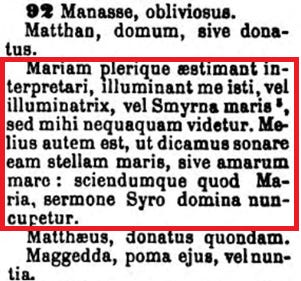
Jerome did not agree with the interpretation of the name Mary as “enlightener”, his proposal is to understand the name as “star of the sea” (stella maris) or “bitter sea” (amarum mare), while noting that Mary can mean “lady” in the Syrian language.
It is widely thought that “stella maris” is a transcription error (back in the day, manuscripts were copied by hand, which is prone to mistakes), and Jerome originally wrote “stilla maris” (drop of the sea), but the name caught on. Since the Early Middle Ages, Mary has been referenced as “Our Lady, Star of the Sea”.
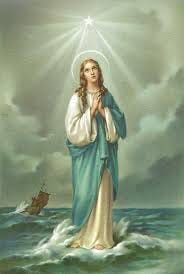
You are probably wondering where I’m going with this. Next to being an interesting piece of Church history, this helps explain the name of the company I am writing about. So let’s come back to our millenium - Our story starts in 2018.
2018 - Cie de l’île de Groix
In November 2018, Bolloré SE established one of its myriad of small companies, mostly named after places in Brittany, a société par actions simplifiée (SAS) with a capital of 1000€, and named it “Compagnie de l’île de Groix”
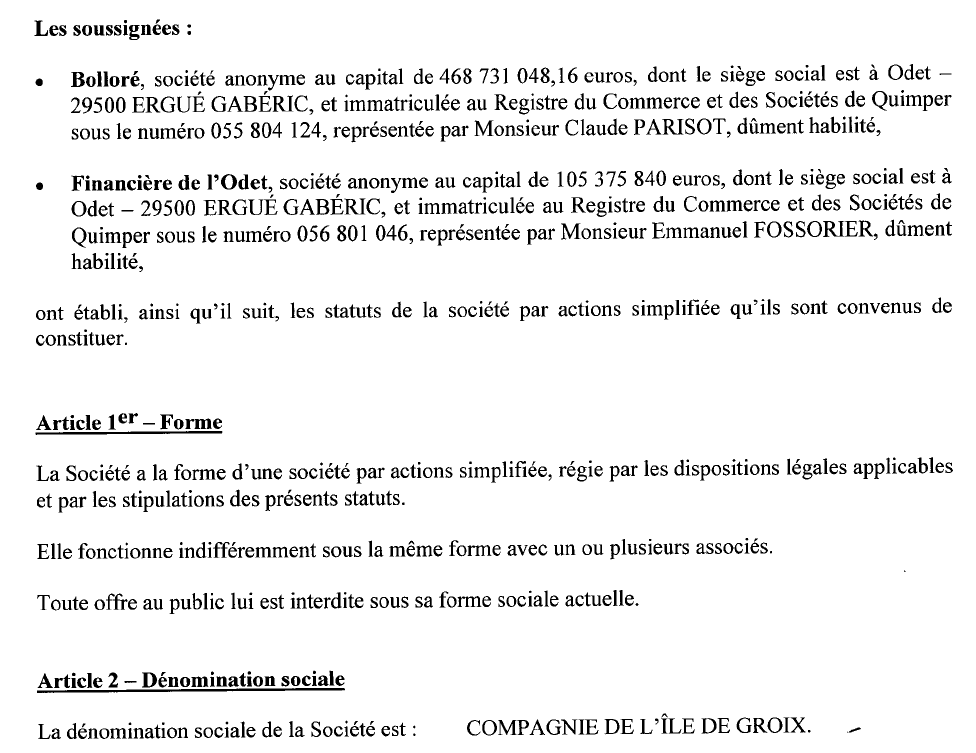
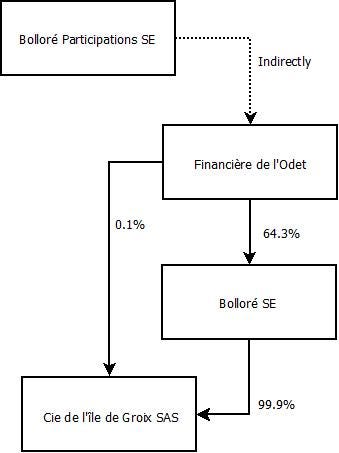
Groix is an island off the coast of Brittany, also called the “Garnet island” after the many gemstones that can be found there. The capital of the company was 99.9% owned by Bolloré SE (99 shares of 10€) and 0.1% owned by Financière de l’Odet SE (1 share of 10€) - since an SAS needs at least two shareholders.
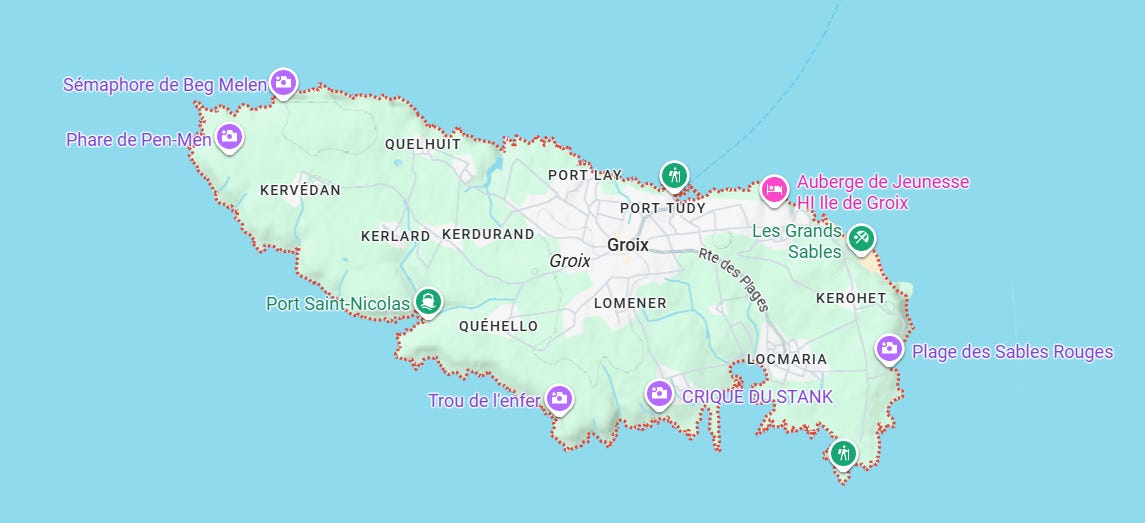
Nothing noteworthy or spectacular so far, the company seat was in the Bolloré tower in Puteaux like all the other countless little shell companies within the group. Francois Laroze was named first president of the company.
For 2018, nothing to report - the company had 2000€ of operating costs and thus made a minimal loss and ended up with negative equity.
2019 - Marisstella
In 2019, the company incurred another 3000€ of operating costs - and had no revenues or other activity.
In December 2019, the name of the company was changed to “Marisstella” - and now you probably understand the introductory paragraph a little better. Vincent Bolloré is a devout catholic and decided this was a more appropriate name for what he had planned.
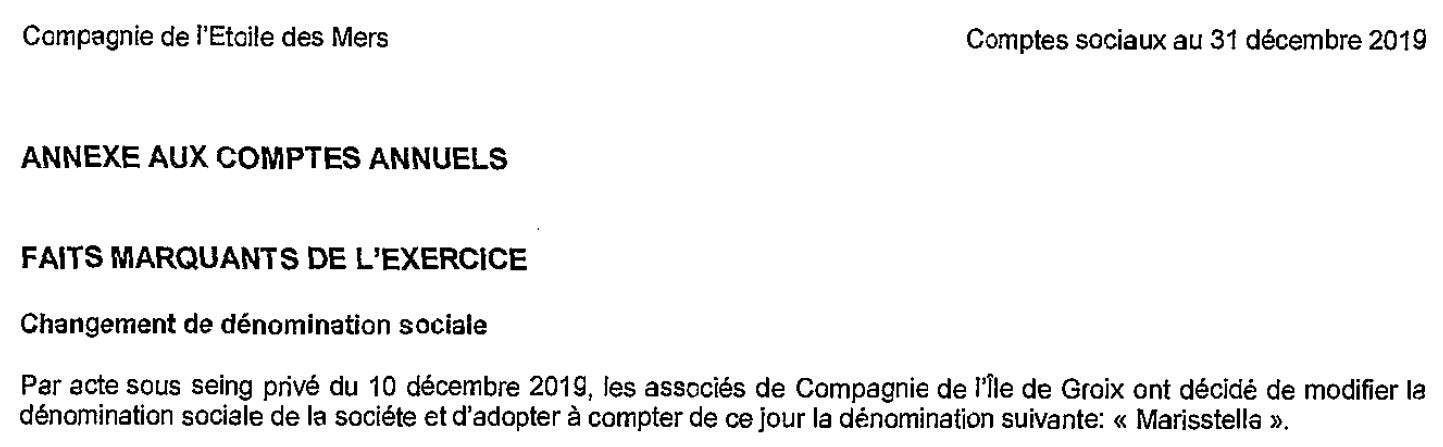
The name did not hold long though, as the latin name was translated into french just a few days later (but in 2020, on January 10th) and the company adopted its new name that it has kept until now: la Compagnie de l’Étoile des Mers (Star of the Seas company)
2020 - Compagnie de l’Étoile des Mers
2020 was the year of COVID-19. Stock markets crashed, the world went into lockdown. Vincent Bolloré went into action.
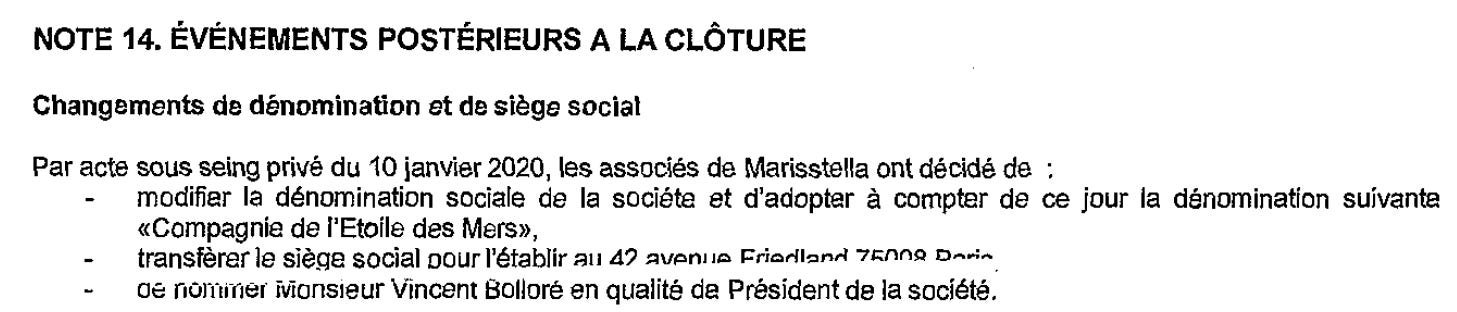
In January, Marisstella was renamed “Compagnie de l’Étoile des Mers”, the seat was transferred to 42 av. Friedland (HQ of Vivendi) and Vincent Bolloré himself took over as president. Ownership of the shares also changed to its present form, with the family holding company (Bolloré Participations SE) taking a 51% shareholding, and Financière de l’Odet taking 49%.
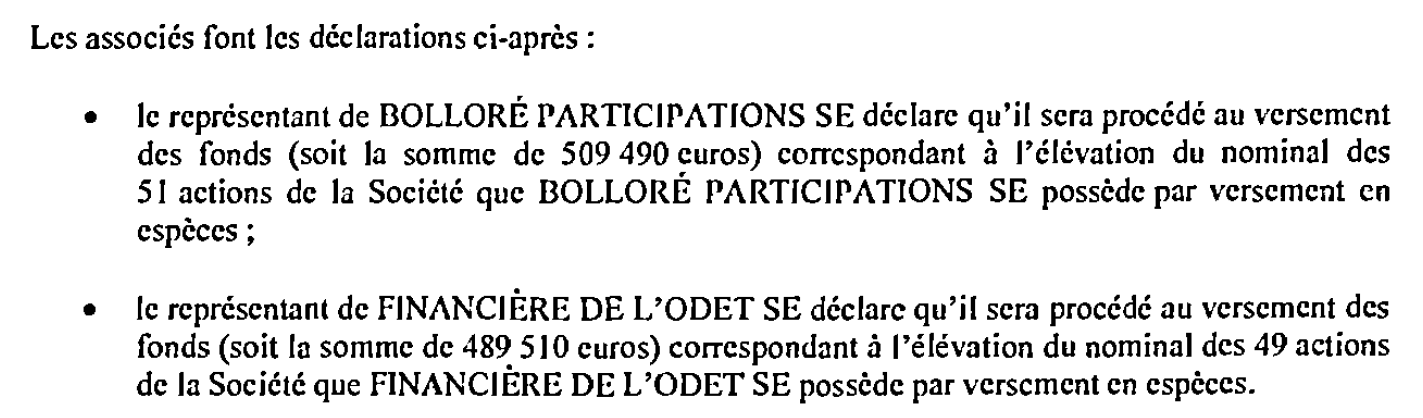
Ten days after renaming the company, the capital was increased from 1000€ to 1 million € (100 shares of 10,000€).
With the share price of Bolloré SE at very low levels, the company went on a buying spree.
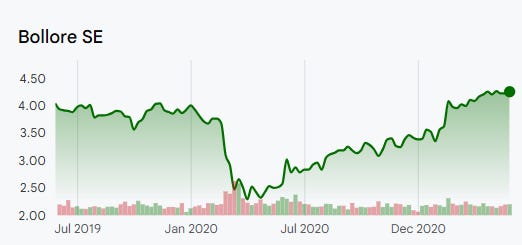
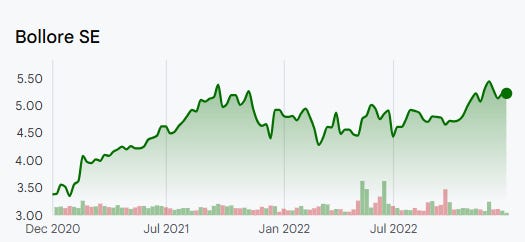
“Our Lady, Star of the Sea”, inc. went out and bought nearly 10 million shares of Bolloré SE for a total of 22.9 million € (an average price of 2.32€ per share), nearly perfectly picking the bottom in 2020.
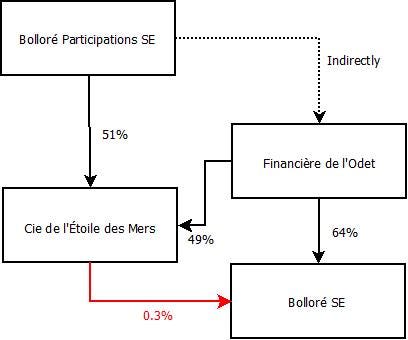
How was this possible with a capital of only 1m€? The parent companies advanced some money (to be converted into equity later in the year) and a bank loan of 10.8m€ was provided.
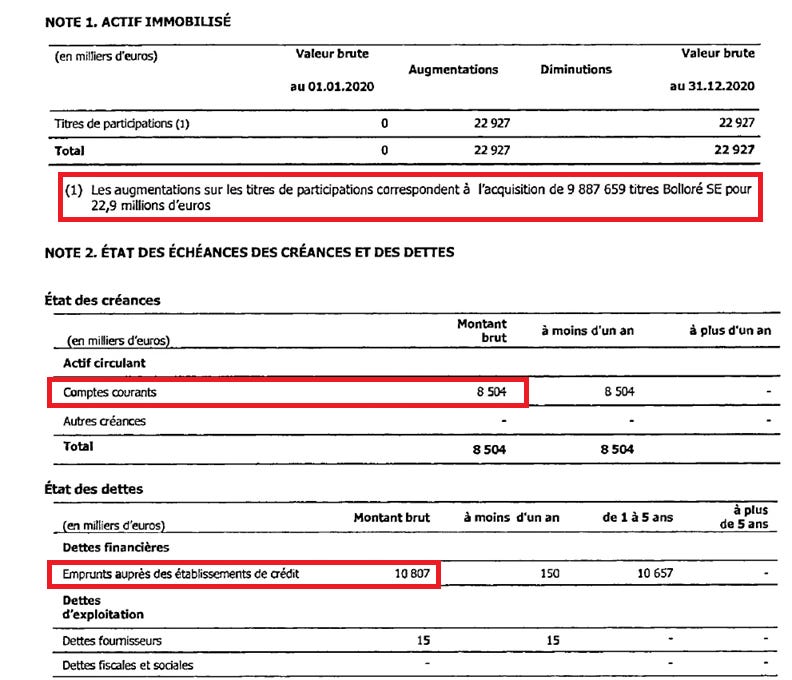
At the end of the year (in October), the capital of the company was increased to 21m€ (100 shares of 210,000€).
What did the balance look like at the end of 2020? There was a cash cushion of 8.5m€ left after paying various operating costs, and receiving around 600k€ in dividends from Bolloré SE and interest, and paying 530k€ in interest on the bank loan.
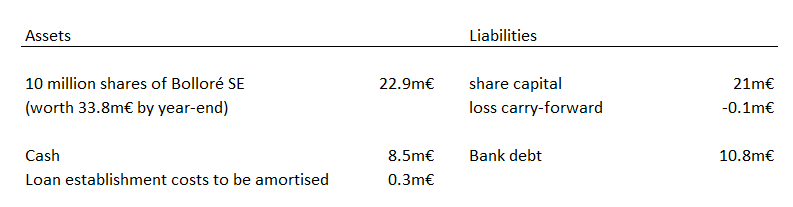
So we deduce:
Vincent Bolloré (VB) structured the loan so that the dividend from Bolloré SE would cover the interest costs of the bank loan in the first year.
Odet and Bolloré Participations must have advanced originally some 12-13m€ to the company to have the equity to go ahead with the purchases, the bank loan was probably provided on a 50% equity requirement (23m€ purchase, 11m€ bank loan, 12m€ equity). So VB was buying on margin, but knew he could cover the interest cost, and very quickly (a few months later) put in additional capital in cash to reduce the leverage
The loan has a term of “1 to 5 years” according to its classification on the balance sheet, so this was not a short-term margin loan (we will find out later that it was a 3-year loan)
By the end of the year, the situation was quite comfortable with assets of 42m€ (with Bolloré stock at market price) and 11m€ of debt.
2021 and 2022 - let it ride
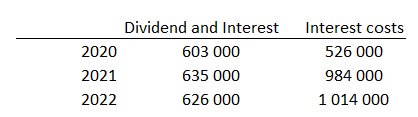
during 2021 and 2022, the company did - absolutely nothing. It just collected the dividends and paid the interest on the loan. And enjoyed the appreciation of the value of Bolloré SE shares on the stock market. However, the rising interest rates did put a dent into the cash reserves as the dividend could not fully cover the interest costs anymore.
Looking at the interest costs, we discover that - although the amount of the loan stayed more or less constant - the interest costs strongly increased. In 2022, the remaining term was “less than one year”, so it became apparent that it was a 3-year loan, probably structured with rising interest (something like 5% in year 1, and 10% in years 2 and 3). The bank did still make a nice cut out of this loan.
By the end of 2022, the market value of the Bolloré SE shares had increased to 52m€ (nearly double the purchase price).
2023 - Cashing in
After finalising the sale of the African logistics business, Bolloré SE initiated a tender offer on its shares in April 2023 at a price of 5.75€ per share (to be topped up by 0.25€ after the sale of the remaining logistics business to CMA-CGM later).
Compagnie de l’Étoile des Mers tendered all its shares, repaid the loan in full - and booked a profit of 34m€. It now had 54m€ in cash, raked in a little more than 1m€ in interest for the rest of the year, and paid 864k€ in taxes.
Vincent Bolloré had turned 21m€ into 54m€ (after taxes and costs) within 3 years. 37% CAGR. Nice.
2024 - the next chapter
Having a nice little cash-rich shell is a solid foundation to build on. So it was time to use it for a new purpose.
In March 2024, the company cashed in the 0.25€ price completement on the Bolloré SE tender offer (2.5m€), and paid a dividend to its shareholders of 1m€.
During 2024, the plan of splitting Vivendi into 4 different entities was established, and consummated in December of the year. Yannick Bolloré (YB) [Vincent Bolloré’s son] was to lead HAVAS N.V., the advertising arm of Vivendi (which had a long history with the Bolloré group before, but that’s another story for a different time), and created his own company “YB6” to hold/buy shares of HAVAS.
Our Lady, star of the seas, gave him a helping hand and loaned 17.5m€ to YB6 for a term of 66 months and interest of Euribor + 125bps. YB had to pledge shares in Bolloré Participations (the family holding) as collateral for the loan. YB6 went out and purchased HAVAS shares on the market as soon as they became available to trade.
2025 - Becoming a large HAVAS shareholder
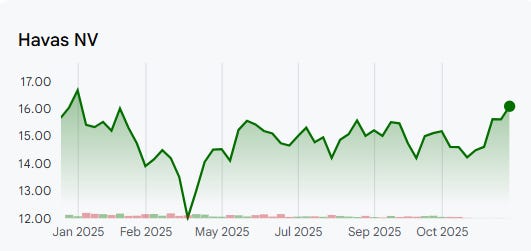
Vincent Bolloré followed his son’s example, and started to buy as well. During 2025, Cie de l’Étoile des Mers purchased a total of 13.98% of HAVAS for 204.5m€ (average price: 14.75€). This time, not financed by a bank loan - but by shareholder advances. L’Odet had sold its stake in Universal Music Group (UMG) for a very nice price, and placed some of the proceeds at its investee company as a shareholder loan.
How the balance sheet looked like at the end of 2025:
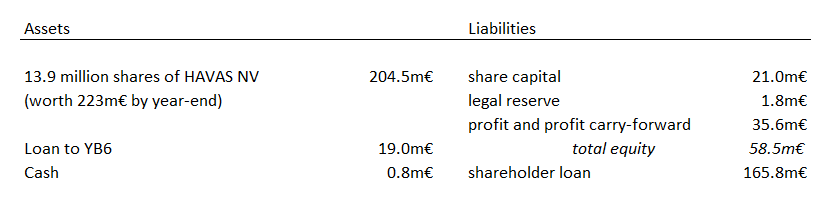
So equity (at market value of HAVAS) increased to around 77m€ (still nearly 30% CAGR since 2020).
The company cashed in 2.3m€ in dividends from HAVAS and ~900k€ from interest. It paid 1.1m€ in interest costs. We don’t know what the remuneration is on the shareholder loan.
A holding of 5.7m shares was reported in August 2025, and 8.9m shares in November 2025 - and 13.9m shares on December 31, 2025 implied from the 13.98% shareholding. So we can assume a large part of the shareholder loan was only called up during the latter half of the year, my speculation the interest is something around ~4% (similar to the loan Vivendi gave to Lagardère).
2026 - still buying
We obviously have no annual accounts for 2026 yet, but a few things have happened that we know about: The company kept buying up HAVAS shares, it reported owning 22.4m shares (22.6% of the company) in February 2026, after buying more shares on the market and absorbing the company YB6 (which held nearly 3% of HAVAS). The current market value of these shares is 415m€, and they will deliver an annual dividend income (pre-tax) of around 18m€. HAVAS itself is buying back shares (more than 2% so far), and also started buying up Louis Hachette Group shares (an other entity created from the Vivendi split), so far a 2% stake.
The current state of affairs looks like this (without the control loops):
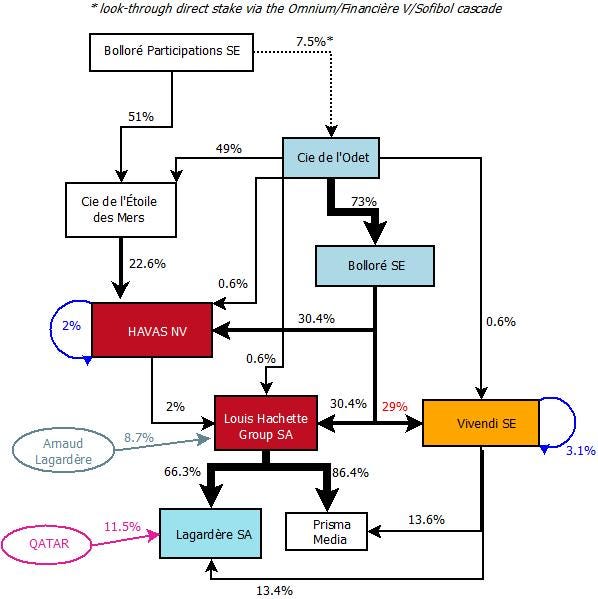
Through the vehicle “Maris Stella”, Vincent Bolloré has constructed a new “side cascade” through which Bolloré Participations has a more direct control over HAVAS. And made a lot of money in the process, by buying in at the right time, at the right price - both at Bolloré SE (when it was trading at rock-bottom prices during the COVID crash), and at HAVAS when it was being dumped by institutions after the Vivendi split.
The future
I have noted that in 2025, another vehicle has been created.
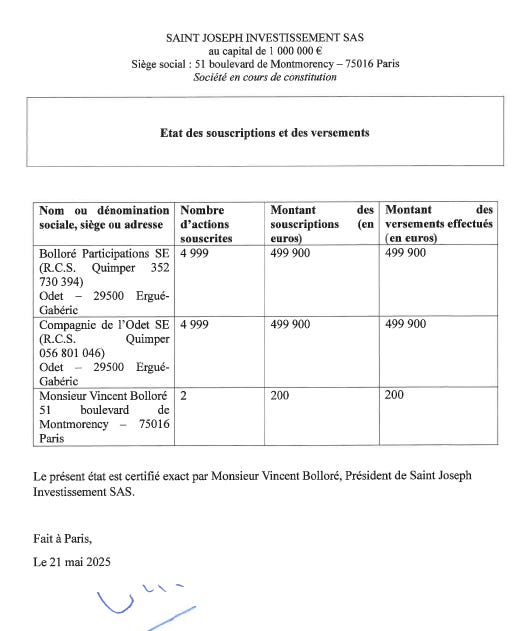
Its name is “Saint Joseph Investissement”. Its share capital of 1m€ is owned 49.99% by Bolloré Participations, 49.99% by Compagnie de l’Odet, ans 0.02% by Vincent Bolloré himself.
Who is Saint Joseph? None other than Mary’s husband.
Mary, Our Lady, Star of the Seas.
I leave you with a recording of the medieval hymn “Ave Maris Stella”, that gave the article its title.
The article is dedicated to my friend Peter, who sadly and very unexpectedly passed away two days ago. If you have read these lines, spare a thought for him, his partner and the small daughter he leaves behind.
Thanks for taking the time to put this piece together. Made for a very interesting read!
Thank you for the excellent piece and for your commitment to sharing your knowledge and expertise. My condolences for your loss.